Central Intelligence Project
An independent research, analysis, and coordination organization focused on complex problems that cross traditional professional, institutional, geographic, and disciplinary boundaries.
Most difficult problems are not confined to a single field. Public safety intersects with public health. Infrastructure intersects with economics and emergency management. Law intersects with technology, human behavior, finance, government, and history. Information relevant to one investigation may exist inside an entirely different organization, profession, jurisdiction, dataset, or body of research.
Each participant may possess an accurate piece of the picture while no one possesses the complete picture. The Central Intelligence Project was created to work in that space.
Connecting What Is Already Known
Modern organizations generate enormous amounts of information. Governments collect records. Researchers publish findings. Investigators develop evidence. Journalists document events. Businesses maintain operational data. Communities preserve local knowledge. Subject matter experts accumulate decades of specialized experience.
The problem is often not the absence of information. The problem is that the information is separated.
Different organizations use different terminology, databases, reporting structures, professional standards, jurisdictions, and analytical methods. A connection that appears obvious to an expert in one discipline may be effectively invisible to someone working in another.
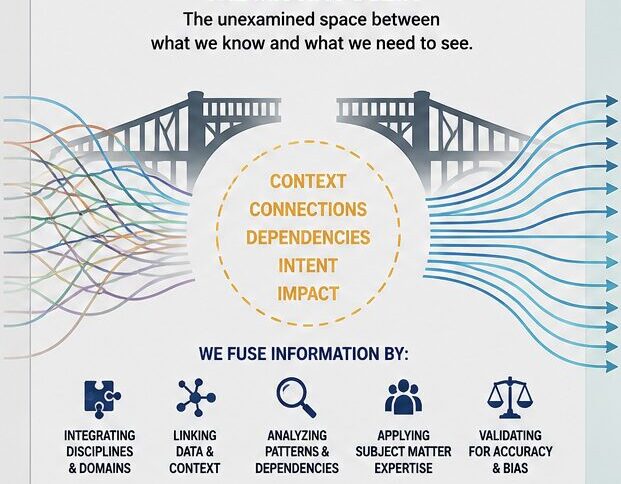
Central Intelligence Project researches across those boundaries, organizes information into a common analytical framework, identifies relationships and information gaps, and helps connect the people and organizations capable of resolving them.
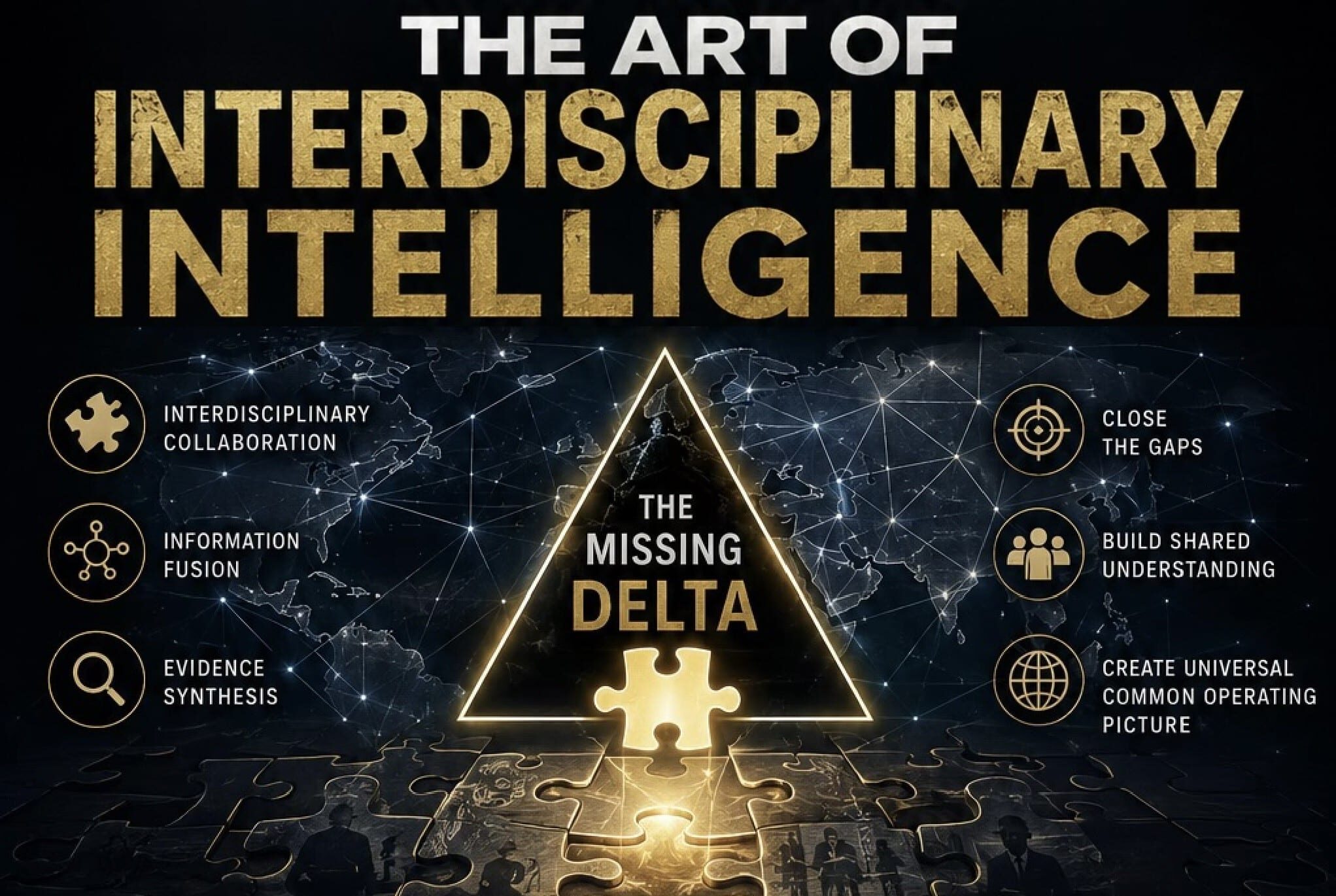
The Art of Interdisciplinary Intelligence
Interdisciplinary intelligence is the deliberate integration of information, expertise, perspectives, and analytical methods from disciplines that are normally examined separately.
Instead of asking only what a particular dataset, investigation, profession, or organization knows, we ask what becomes visible when those sources are examined together.
This requires more than collecting information.
It requires understanding context: how different systems operate, how terminology changes between disciplines, how events develop over time, how organizations interact, and how apparently unrelated observations may represent different manifestations of the same underlying condition.
We call this approach The Art of Interdisciplinary Intelligence.
The Missing Delta
In mathematics and science, delta represents change or difference.
For Central Intelligence Project, The Missing Delta is the consequential difference between what can be understood from isolated pieces of information and what becomes visible when those pieces are properly integrated.
The missing information may already exist
The missing element may instead be a relationship, chronology, contradiction, translation between disciplines, overlooked source, unidentified expert, jurisdictional connection, or question that no individual participant had reason to ask.
Finding that delta can transform disconnected information into actionable understanding.
From Information to Understanding
Central Intelligence Project does not replace investigators, researchers, government agencies, universities, businesses, journalists, community organizations, or subject matter experts.
It helps connect them.
Our work begins by determining what is known, what is not known, who is likely to know it, where additional information may exist, and which disciplines need to be brought together to understand the problem.
The objective is not simply to accumulate more information.
It is to identify the information that changes what we understand.
Client Assistance and Professional Services
Central Intelligence Project provides non-attorney assistance with military-related matters, disability accommodation advocacy, records reconstruction, and other complex administrative or evidentiary needs.
Our work begins with an Interdisciplinary Intelligence Assessment of the client’s circumstances.
Rather than examining a single form, diagnosis, claim, agency, or administrative action in isolation, we evaluate the broader system surrounding the client. This may include military service, occupational exposures, medical history, disability, employment, education and training, administrative records, prior claims and decisions, missing documentation, agency responsibilities, applicable standards, and the evidence necessary to support informed decision making.
The scope of assistance varies according to the complexity of the matter, the resources required, and the professional services involved.
Some assistance is provided without charge. Other services may be provided through paid professional services, contracted research or consulting arrangements, or coordination with qualified outside professionals. Services may include, but are not limited to:

Military and Veteran Matters
Research and assistance involving military records, service history, occupational exposures, disability related evidence, Department of Veterans Affairs matters, Combat-Related Special Compensation, Boards for Correction of Military Records, and related administrative processes.

Disability Accommodation Advocacy
Assistance identifying functional limitations, accommodation requirements, supporting evidence, institutional responsibilities, and coordination needs involving employment, education, government services, or other settings.
Professional Services
We offer a range of professional services including multi-agency coordination, research and evidence development, training and consultation, expert analysis and testimony, and decision support tools.
Interdisciplinary Research Projects
Our research doesn’t tend to follow conventional norms. Most research projects remain confined by specific areas of study: medicine, physical sciences, history, military operations, genealogy, engineering, politics, or similar boundaries. We prefer to blend these areas into a fusion across these realms to demonstrate what is lost between the cracks, providing a new understanding of the information that is traditionally known.
Organic Atomic Node Intelligence (OANI)™
Artificial Intelligence (AI) has transformed the world as we know it. Companies and governments alike are investing millions into advancing this technology. Nearly every computer program, application, and website now incorporates AI, whether we like it or not.
For many applications, AI can be very beneficial. It can explain ideas, teach new skills, render graphics, schedule tasks, and help automate various aspects of daily life to make things easier.
AI can also get things wrong. A picture may not be completely accurate, but most people might not notice. Instructions might be based off a previous model of equipment, but close enough to the one you’re working on to allow you to complete a repair. That’s fine if the task is mundane, or if you know enough to understand what really needs to be done.
But what about when there’s no room for error? In high-consequence scenarios, good enough isn’t. Information needs to be precise. Precision doesn’t allow for guessing. This is where using The Art of Interdisciplinary Intelligence to find The Missing Delta shines. Depending on the complexity of the subject though, it can be very labor intensive.
Much of our research has been dependent on a collection of databases, websites, books, records, and other sources that have to be searched individually over, and over, and over again. There had to be a better way. Using principles often found in cryptography, we started noticing patterns. Information was no longer chapters and paragraphs, but rather words and characters. It was like breaking mathematical formulas down to the prime numbers, chemicals down to the elements, organs down to the cells. But elements and cells are made up of atoms. Atoms are made up of bosons and fermions.
What if information could be broken down to an atomic level? That’s exactly what we’re working on, and we call it Organic Atomic Node Intelligence, or OANI for short. We’re taking our research, breaking it down to an atomic level, and mapping the relationships between the nodes of information to create a new way of computing data. Unlike AI, which uses probabilistic reasoning to try to figure out what it doesn’t know, OANI is being designed using deterministic reasoning to understand what it know, what it doesn’t know, and where to find The Missing Delta.